
8 products
-

 3-IN-1 BENTO (Lick Mat + Slow Feeder)3-IN-1 BENTO (Lick Mat + Slow Feeder)
- Regular price
-
$59.00 - Regular price
-
$59.00 - Sale price
-
$59.00
Quick view
-

 Zogoflex Toppl (Bubble Gum)Vendor:Zogoflex Toppl (Bubble Gum)West Paw
- Regular price
-
$35.00 $55.00 - Regular price
-
- Sale price
-
$35.00 $55.00
Quick view
-
 Zogoflex Toppl (Periwinkle)Vendor:Zogoflex Toppl (Periwinkle)West Paw
- Regular price
-
$35.00 $55.00 - Regular price
-
- Sale price
-
$35.00 $55.00
Quick view




WHY SLOW FEEDING
Dogs that eat too fast swallow air along with their food, which can lead to bloating, discomfort, regurgitation, and poor nutrient absorption. In serious cases, fast eating is a contributing factor to gastric dilatation-volvulus (GDV), a life-threatening condition more common in large and deep-chested breeds. Slow feeders solve this by forcing your dog to eat at a healthier pace — navigating ridges, licking through channels, or working food out of textured surfaces instead of gulping from an open bowl. The slower pace also makes mealtime more mentally stimulating, which means your dog feels more satisfied after eating the same amount of food.
TYPES OF SLOW FEEDERS
Slow feeder bowls — Bowls with raised ridges, mazes, or obstacles that prevent your dog from taking large mouthfuls. They work with any type of food — raw, air-dried, rehydrated, or wet. The simplest swap you can make: replace the regular bowl and mealtime changes immediately.
Lick mats — Flat, textured surfaces designed for wet food, spreads, or soft meals. Your dog licks the food off the surface rather than gulping, which is naturally calming — the repetitive licking action releases endorphins. Lick mats can be frozen for an even longer session and are useful beyond mealtime: during baths, grooming, nail trimming, or as a settling activity.
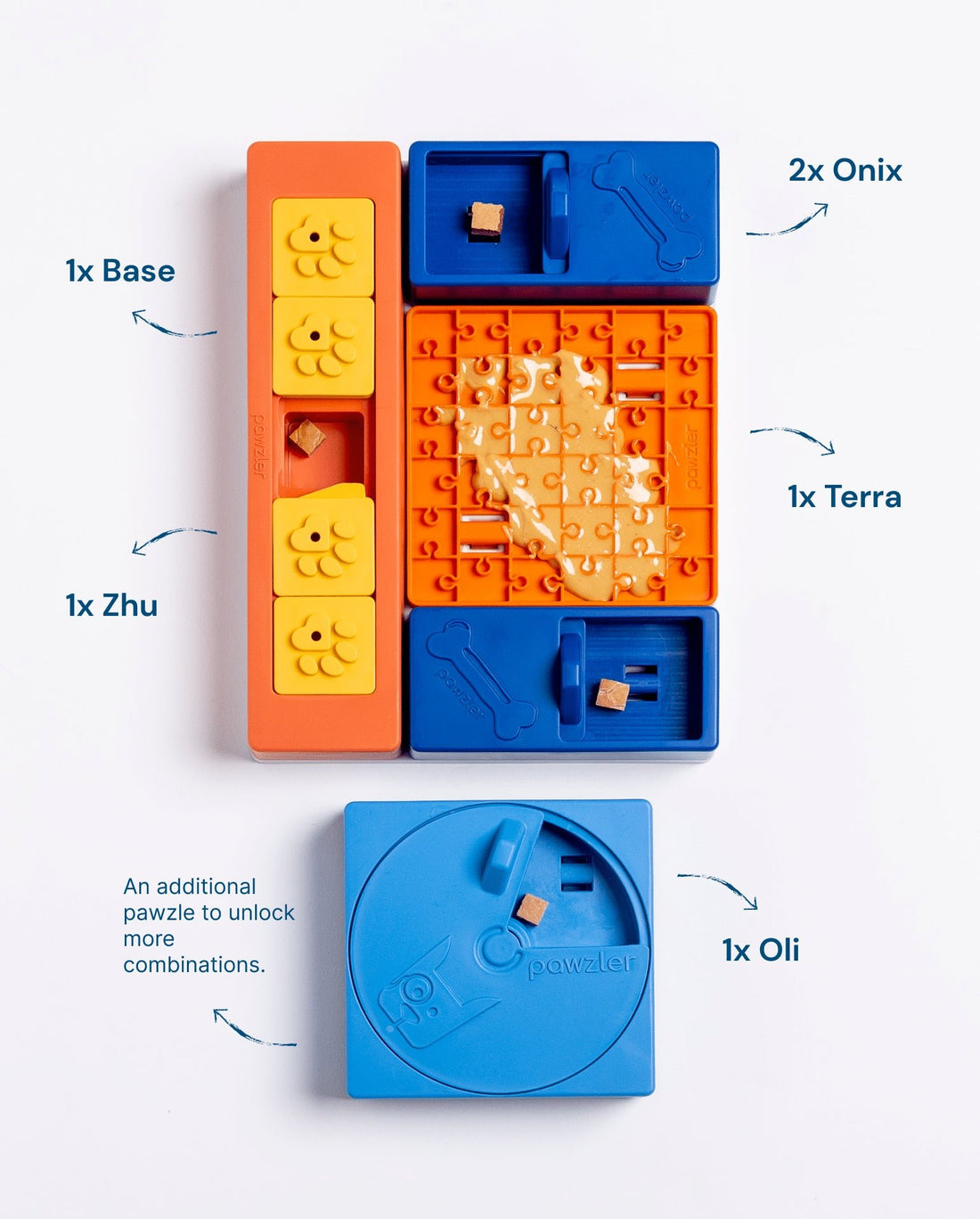
Puzzle feeders — Feeders that combine slow feeding with problem-solving. Your dog has to move, slide, or manipulate parts of the feeder to access the food. These offer the most mental stimulation of any slow feeder type. For a dedicated puzzle experience, see our puzzle toys collection.
FREQUENTLY ASKED QUESTIONS
How do I know if my dog needs a slow feeder?
If your dog finishes their meal in under two minutes, gulps food without chewing, or regularly experiences bloating, gas, or regurgitation after eating, a slow feeder is worth trying. Most dogs that switch to a slow feeder show noticeable improvements in digestion and mealtime behaviour.
Will a slow feeder frustrate my dog?
Most dogs adjust within one or two meals. Start with an easier pattern — wider ridges, shallower channels — and move to more complex designs as your dog gets comfortable. The goal is to slow eating down, not make it stressful. If your dog seems genuinely frustrated, try a simpler design or use a lick mat instead.
Can I use a slow feeder with raw food?
Yes — slow feeder bowls work well with raw, air-dried, rehydrated, and wet food. Lick mats are particularly good with raw or wet food because the flat surface encourages licking rather than biting. Choose a feeder that's easy to clean thoroughly, especially when using raw food.
How do I clean a slow feeder?
Most slow feeders are dishwasher safe — check the product page for care instructions. For feeders with deep ridges or intricate patterns, a bottle brush or toothbrush helps reach the grooves. Clean after every meal to prevent bacteria buildup, especially in Singapore's humidity.
Can I use a slow feeder for puppies?
Yes — slowing down eating is beneficial at any age. Choose a size and pattern appropriate for your puppy's muzzle. Puppies that learn to eat at a controlled pace from the start are less likely to develop fast-eating habits as adults.
What's the difference between a slow feeder and a puzzle toy?
A slow feeder's primary purpose is to slow down mealtime — the food is visible and accessible, just harder to gulp. A puzzle toy requires your dog to solve a mechanical challenge to access the food. Both provide enrichment, but slow feeders are designed for daily meals while puzzle toys are typically used for treats or supplementary feeding. Shop Puzzle Toys →
Where can I see slow feeders in person?
Everything in this collection is available at our Wheelock Place store — 501 Orchard Road, #01-K3, Singapore. Open daily, 11am–7pm. Our team can help you choose based on your dog's eating speed, foo